 Midas
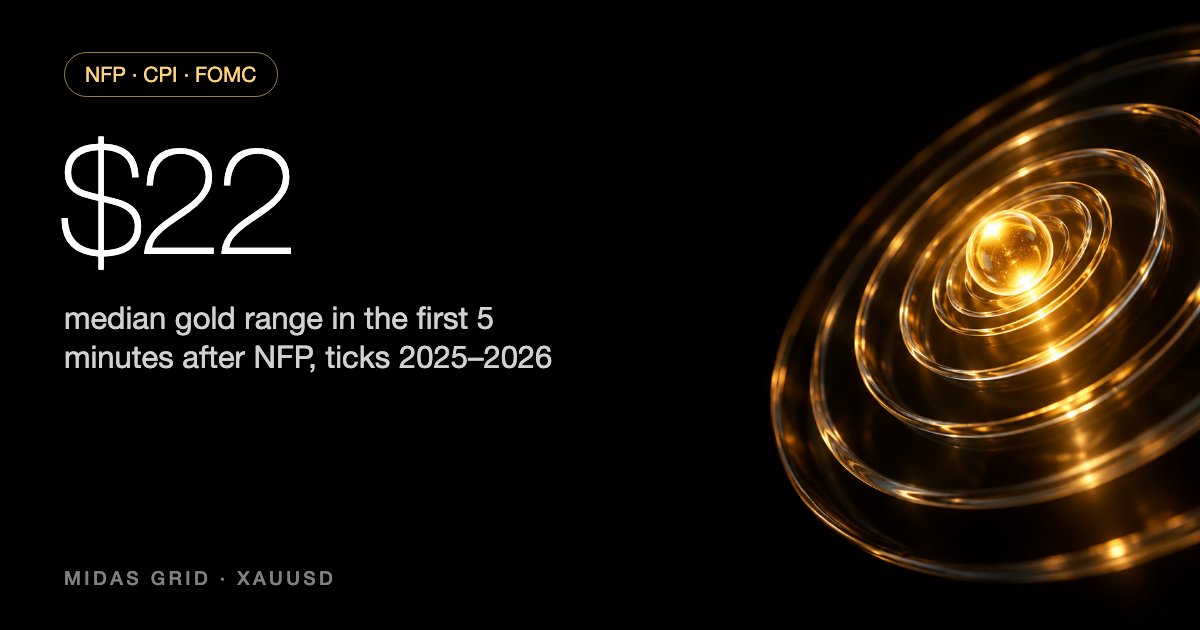
On FOMC, NFP and CPI days gold does not so much travel further over the day as move faster. In our tick data for 2025–2026, the first five minutes after NFP covered a median $22, more than a whole ordinary hour at that time of day, and the spread in the first minute peaked at about six times its usual width. The direction of that move was a coin toss.
Measurements on past ticks, not a forecast. Trading with leverage carries risk: if the deposit is too small, a stop-out is possible.
See also: 7 protections for a martingale grid bot on gold →
On this page (10)
Why does gold react to US data and the Fed?
Gold pays no interest and is priced in dollars, so it reacts to two things these releases change: the expected path of US interest rates (and with it real yields) and the dollar. Higher expected rates make holding a zero-yield metal more expensive in lost interest; a stronger dollar makes gold dearer for everyone else. The World Gold Council links almost all major gold pullbacks, mainly or partly, to this opportunity cost of real rates and the dollar (World Gold Council).
What moves the price at 8:30 a.m. in New York is the surprise against the consensus, not the number itself. Expectations are already in the price; the market reprices only the difference. Andersen, Bollerslev, Diebold and Vega showed this for currencies: announcement surprises produce quick jumps in the exchange rate, and bad news has a larger effect than good news (American Economic Review, 2003). A "strong" jobs number that everyone expected can leave gold flat, while a modest miss in core CPI can move it $30.
The details matter as much as the headline: in the jobs report, revisions to previous months, the unemployment rate and average hourly earnings; in CPI, the core index without food and energy. The slower drivers of gold are covered in what moves the gold price.
When do the releases come out?
- NFP (nonfarm payrolls, the Employment Situation report of the Bureau of Labor Statistics): usually the first Friday of the month at 8:30 a.m. Eastern time (BLS schedule). That is 12:30 UTC while US daylight saving time is on and 13:30 UTC in winter.
- CPI (consumer price index): mid-month, also 8:30 a.m. Eastern (BLS schedule).
- FOMC (the Fed's rate committee): eight scheduled meetings a year (Fed calendar). The statement comes at 2:00 p.m. Eastern and the Chair's press conference starts at 2:30 p.m., so there are two waves. Four meetings a year (March, June, September, December) also publish the projections of rates, the "dot plot".
Dates and times for the next three months are in the table below.
How much does gold move after the release? Our tick data
We took every NFP, CPI and FOMC release from January 2025 to October 2026 (20 NFP, 21 CPI, 13 FOMC; two days were dropped because of gaps in the data or a holiday market) and compared each with the same weekday and the same UTC time on ordinary days within four weeks (327 windows; days with other major releases excluded). Range is the distance between the highest and the lowest bid price in the window, measured from the last price before the release.
| Median (90th percentile) | NFP | CPI | FOMC statement |
|---|---|---|---|
| Range in the first 5 min | $22 ($64) | $17 ($50) | $22 ($51) |
| Same 5 min on an ordinary day | $6 | $6 | $4 |
| Range in the first 15 min | $31 ($69) | $21 ($69) | $28 ($58) |
| Range in the first 60 min | $36 ($69) | $32 ($72) | $47 ($102) |
| Same 60 min on an ordinary day | $17 | $19 | $11 |
| 5 minutes, in ordinary hours at that time | 1.5 | 1.2 | 1.6 |
| 60 minutes, in ordinary hours at that time | 2.6 | 1.8 | 3.0 |
| Whole UTC day vs an ordinary day | ×1.18 | ×1.14 | ×1.27 |
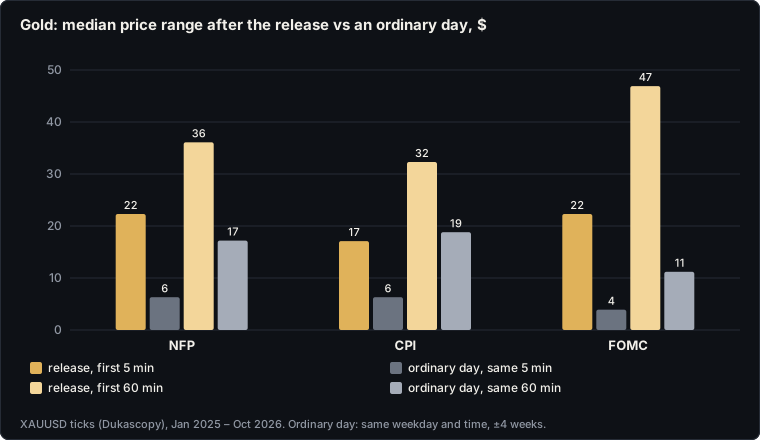
Three things stand out:
- The move is compressed in time. Five minutes after NFP carry more range than an entire ordinary hour at 12:30–13:30 UTC. Yet the whole day is only 14–27% wider than an ordinary day of the same weekday: release days are not "crazy days", they are ordinary days with a burst.
- FOMC is the largest of the three over an hour, and the press conference moves gold more than the statement. In the 30 minutes after the statement the median range was $30; in the next hour, which holds the press conference, $45 (ordinary days: $9 and $11).
- Volatility grew with the price. NFP's first hour had a median range of $30 in 2025 and $63 in 2026; ordinary hours at that time grew too, from $14 to $21. In percent, NFP's first hour was about 1.0% of the price against 0.4% on an ordinary day.
How often does gold run $20 from the pre-release price?
Within four hours of the release, gold moved at least $20 away from its last pre-release price in 95% of NFP days (ordinary days at that time: 65%), 90% of CPI days (73%) and 92% of FOMC days (23%). Across all three, 93% against 57%. Our earlier measurement on a shorter history gave 87% against 65%; the effect held on the longer base.
On NFP the median time to $20 was 6.3 minutes, and in 6 of 19 cases it took less than eight seconds. Within the first hour the price ran at least $40 from the pre-release level on 40% of NFP days, 29% of CPI days and 46% of FOMC days; on ordinary days at those times, 1–5%.
What happens in the minute of the release?
The minute of the release has its own structure, and most of it is about liquidity, not about the number.
- Liquidity is pulled before the number. Market makers do not want to be filled at a price that is about to be stale, so they widen quotes or step back. In our data the average spread was already wider in the minute before NFP: $1.04 against $0.64 on an ordinary day.
- The spread peaks in the first seconds. The widest spread inside the first minute had a median of $5.95 on NFP, $5.81 on CPI and $4.94 on FOMC, against $0.94 on an ordinary day; in one release out of ten it went above $11–15. Within minutes 2–5 it was almost back to normal ($0.96 on NFP).
- Fills differ from the chart. In MetaTrader 5, market orders are filled at the price the broker gives, and stop orders at the stated price or worse, with slippage (MetaTrader 5 Help). When price jumps $10 in a second, a pending order or a grid level can be filled several dollars away from its level.
- Saw-tooth both ways. After the first five minutes, price came back to the pre-release level at least once within the hour on half of NFP and CPI days and 62% of FOMC days. Spikes through obvious levels that then snap back, the "stop hunt" traders talk about, are the visible part of this.
- But the first impulse usually sets the direction of the hour. The sign of the move after 60 minutes was opposite to the sign after 5 minutes on only 2 of 20 NFP days, 29% of CPI days and 31% of FOMC days; on ordinary days, 39–48%. So "the first move always reverses" is a myth on our data: the first move often retraces deeply, but most of the time the hour ends on the same side.
- The direction itself cannot be called in advance. The first five minutes went up on 52% of release days. A study on Treasuries shows the same mechanics in another market: the spread widens sharply at the announcement and stays moderately wide for a while (Fleming and Remolona, Journal of Finance, 1999).
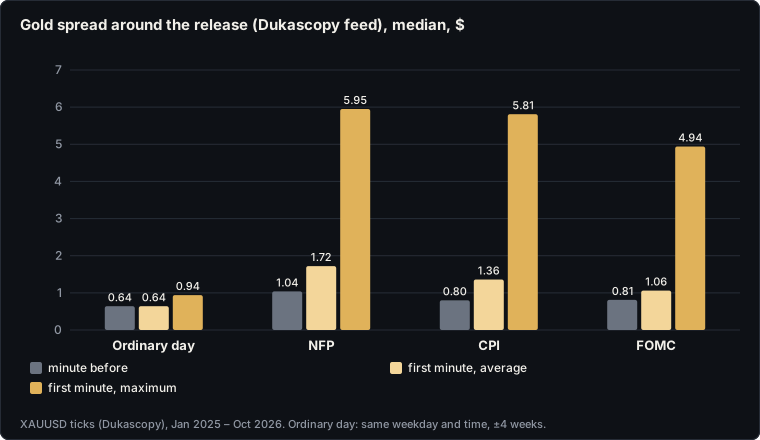
The spread figures are from the Dukascopy feed. A retail broker's spread is usually wider and its widening at the release can be larger; check yours in Market Watch on the next release.
What does this mean for a grid Expert Advisor?
A grid adds orders as price moves against the basket. What hurts it is how far price runs from where the basket started, and how fast. A release changes both: in our data, a $40 run within an hour happened on 40–46% of NFP and FOMC days against about one ordinary hour in twenty.
Take the default inputs of our grid calculator: start lot 0.01, multiplier ×2, 11 orders, step $1.95, a cent account with a $1,000 balance, leverage 1:2000, stop-out at a 40% margin level. A $10 move against the first order leaves 6 orders open; $20 opens all 11 (20.47 lots), and each further $1 changes equity by $20.47; at about $66 against the first order the account reaches stop-out (the full table). Now compare: the 90th percentile of the run from the pre-release price within the first hour was $66 on NFP and $93 on FOMC. In this example, one release in ten is enough to cover the whole room to stop-out if the basket happens to be on the wrong side. Arithmetic of the settings, not a forecast.
Three conclusions follow from the data:
- The deposit must hold the release move, not the ordinary hour. A deposit sized on quiet hours ($11–19 per hour at those times) will meet $50–100 a few times a year. The safe deposit for your lot and step is what the grid calculator and our deposit study on real ticks are about.
- Guessing the direction does not help. The first five minutes went up 52% of the time. A grid cannot know which side the number will hit, and neither can its owner.
- Speed matters as much as distance. Six NFP releases out of nineteen covered $20 in under eight seconds, at a spread several times normal. Several grid levels can then fill at once, at worse prices than the levels on the chart.
What do traders do by hand, and does a pause help?
Common choices around a release, with what each leaves open:
| What traders do | What it gives | What it leaves |
|---|---|---|
| Nothing: the EA keeps its rules | No missed trades, no manual mistakes | The whole burst lands on whatever basket is open |
| No new baskets from ~15 min before to ~30–60 min after | No fresh basket opened at a 6× spread | A basket already open still takes the move. The FOMC press conference comes 30 minutes after the statement, so a short pause ends before the second wave |
| Close or reduce everything before the number | No exposure to the burst | The cost of closing at the market, and a closed basket loses its way back |
| Smaller lot or more balance behind the same lot | Every loss in dollars is proportionally smaller; more room before stop-out | Profit shrinks in the same proportion; the shape of the risk stays |
| Turn off Algo Trading | No new orders | The EA can no longer manage or close the open basket either (Algo Trading switch) |
The honest summary of our evidence: in earlier tests on the same ticks, pausing new baskets by hours or trading sessions did not reduce stop-outs in the model; the risk sat in baskets already open and in the deposit behind them. We have not found evidence that a news pause does better for a grid, and we do not claim that it does. What clearly reduces the damage of a release is the size of the position relative to the deposit.
Midas reads no news calendar and reacts to price the same way at any time; its risk notes are on the risk page.
Upcoming FOMC, NFP and CPI dates
| Event | Date | UTC | Moscow (UTC+3) | Typical MT5 server |
|---|---|---|---|---|
| FOMC: statement / press conference | Wed, Oct 28, 2026 | 18:00 / 18:30 | 21:00 / 21:30 | 21:00 / 21:30 (UTC+3) |
| US jobs report (NFP) | Fri, Nov 6, 2026 | 13:30 | 16:30 | 15:30 (UTC+2) |
| US inflation (CPI) | Tue, Nov 10, 2026 | 13:30 | 16:30 | 15:30 (UTC+2) |
| US jobs report (NFP) | Fri, Dec 4, 2026 | 13:30 | 16:30 | 15:30 (UTC+2) |
| FOMC: statement / press conference (with projections) | Wed, Dec 9, 2026 | 19:00 / 19:30 | 22:00 / 22:30 | 21:00 / 21:30 (UTC+2) |
| US inflation (CPI) | Thu, Dec 10, 2026 | 13:30 | 16:30 | 15:30 (UTC+2) |
| US jobs report (NFP) | Fri, Jan 8, 2027 | 13:30 | 16:30 | 15:30 (UTC+2) |
| US inflation (CPI) | Wed, Jan 13, 2027 | 13:30 | 16:30 | 15:30 (UTC+2) |
| FOMC: statement / press conference (date tentative) | Wed, Jan 27, 2027 | 19:00 / 19:30 | 22:00 / 22:30 | 21:00 / 21:30 (UTC+2) |
Dates from the official Fed and BLS calendars, checked on 26.10.2026. Many brokers run the MT5 server at UTC+2 in winter and UTC+3 in summer, switching with the US clocks; check your own offset in Market Watch. Past rows hide themselves.
US clocks go back on 1 November 2026, so 8:30 a.m. in New York is 12:30 UTC before that date and 13:30 UTC after it. Your broker's server time is the broker's choice; the server column shows a common setup, not yours. More on hours and spreads: XAUUSD trading hours, spread and swap.
What can go wrong
- The sample is small. 20 NFP, 21 CPI and 13 FOMC releases are enough to see the shape, not to estimate rare tails: the next release can be larger than anything in the table.
- Spreads are from one feed. Your broker can widen more, requote or fill with slippage; in a fast market a stop can be filled far from its price, and a gap can skip grid levels.
- Unscheduled news has no calendar entry. Geopolitics, central-bank comments and tariffs move gold without warning.
- If the deposit is too small, a stop-out is possible. A cent account makes the numbers small, not the risk.
How we measured
Source: XAUUSD bid ticks from Dukascopy, the same base our emulator uses (January 2025 – October 2026); ask prices for the spread were downloaded for the hours around each window. Release times are taken from the official BLS and Fed calendars and converted to UTC by US daylight-saving dates. For every window only ticks at or after the release time are used, and the reference price is the last tick before it. Ordinary days: same weekday and UTC time, ±1 to ±4 weeks, excluding other release days (CPI, NFP, FOMC, PCE, ECB). Skipped: FOMC of 7 May 2025 (gap in the data) and NFP of 3 April 2026 (Good Friday, thin market).
FAQ
How much does gold move on NFP day?
In our 2025–2026 tick data the median range in the first 5 minutes after NFP was $22 and in the first hour $36; one release in ten exceeded $64 within 5 minutes. The whole day was only about 18% wider than an ordinary Friday. The move is fast, not necessarily bigger over the day.
What time are NFP, CPI and the FOMC decision released?
NFP and CPI come out at 8:30 a.m. New York time: 12:30 UTC in US summer time and 13:30 UTC in winter (15:30/16:30 Moscow). The FOMC statement is at 2:00 p.m. New York, 18:00 or 19:00 UTC, and the press conference 30 minutes later. Dates are in the table on this page.
Does the first move after the release reverse?
Often deeply, rarely fully. After the first five minutes price came back to the pre-release level within the hour on about half of NFP and CPI days, but the hour ended on the same side as the first five minutes on 18 of 20 NFP days. On ordinary days the hour flips sides 39–48% of the time.
How wide does the gold spread get at the release?
In the Dukascopy feed the widest spread inside the first minute had a median of about $6 on NFP and CPI and $5 on FOMC, against under $1 on an ordinary day, and above $11 in one release out of ten. It was nearly normal again two to five minutes later. Retail brokers can widen more.
Should a grid EA be paused on news days?
There is no evidence on our data that a pause reduces stop-outs for a grid: earlier tests of hour and session pauses showed no effect in the model, and an open basket still takes the move. What reduces the damage is a smaller position relative to the deposit. A pause can still be a personal choice; it is not a safety system.
Which moves gold more: the FOMC statement or the press conference?
On our 13 FOMC days, the press conference half of the event moved more: a median range of $45 in the hour that holds it, against $30 in the 30 minutes after the statement. A short pause that ends 15 minutes after the statement misses the second wave.
Can you predict the direction of gold after NFP or CPI?
Not from the calendar. The first five minutes went up on 52% of release days. Gold reacts to the surprise against the consensus and to the details of the report, which are unknown until the number lands.
Why are gold moves on news days bigger in 2026 than in 2025?
Because gold itself is higher and more volatile. NFP's first-hour median range rose from $30 in 2025 to $63 in 2026, and ordinary hours at that time also rose, from $14 to $21. Compare moves in percent or against an ordinary hour, as the table does.